Pokemon Champions delivers a great experience. It’s still a disappointment.
Pokemon is a series with a status heavily dwarfed by its quality. It has such a strong concept, such strong themes around humanity’s place within nature, such great designs of both human and creatures alike, yet the games just don’t end up very good. I compare the series to Kirby- both are iconic franchises whose games are often hurt by their target demographics being children who often are playing them as their very first games. As such, there is a tendency towards hand-holding and low difficulty that can be annoying. The difference is that beyond Pokemon’s underwhelming games you can find one of gaming’s most interesting experiences. With the release of Pokemon Champions I and many others were hoping to see competitive Pokemon rise to a well-deserved high place, yet the game’s thoroughly mixed reception might just prematurely end the momentum. With this article I want to explore the many things I love about competitive Pokemon, and the ways that Champions has disappointed me.
First, let’s talk about the official competitive format from The Pokemon Company (TPC) called VGC. In this format, you bring 6 pokemon and take 4 into a double battle against your opponent (who does the same). This results in a very complicated metagame where one team can use multiple strategies- you can use pokemon slots as silver bullets for otherwise bad matchups, not to mention the thousand other ways to differentiate one team from another to gain an advantage. The skill from team building alone is incredible, and piloting these teams is even more precise. Skilled players, easier access, and fantastic content creation from youtubers like Wolfe Glick have resulted in this format exploding in popularity.
While you can deride the very idea of competitive pokemon as a sort of competitive rock-paper-scissors, it’s much more comparable to competitive trading card games. In games like Magic the Gathering or Hearthstone there is randomness inherent to the game, yes, and certain archetypes may counter others, but accounting for randomness and matchup spread is part of the game. Building a combo deck that doesn’t get rushed down by aggro or a control deck that can disrupt an opponents combo is a core part of the game, and Pokemon has similar layers to it.
For instance, take an archetype like trick room. These teams seek to use the move trick room to reverse the order Pokemon move in (slowest first rather than fastest first) and abuse that advantage with slower Pokemon that might struggle outside of trick room. Trick room has been a consistently strong strategy throughout competitive Pokemon’s history, but it has always been one you can account for. For one, you can disrupt the Pokemon using trick room with moves such as taunt (which requires the target to use attacking moves and causing any other move, such as trick room, to fail) or the move fake out which has increased priority (bypassing speed order) and causes the opponent to flinch, resulting in their move being skipped. These options also have their own counterplay, such as redirection in moves like follow me or rage powder, which forces opposing moves to target its user, or abilities such as armor tail which prevent priority moves such as fake out.
If you’ve played regular pokemon games you might be asking why you’d bother setting up something like trick room at all, can’t you just blast through your opponents with super-effective moves like in the regular games? The answer is that you can - many popular strategies involve utilizing powerful Pokemon spamming their most powerful move - but those ideas are not without risk. For one, you have to contend with bulky teams that might survive your hits and be able to strike back and KO your frail Pokemon (Trick room teams are solid at this as they can forego speed to train bulkier Pokemon instead), or an opponent might prevent your attack through fake out, status, out-speeding your attacker, or using the format’s most important move, protect. Protect is essential in double battles where your Pokemon can be attacked by two opponents and where you stand to gain a lot by preventing an opposing attack with one Pokemon while its teammate acts. There’s few things better than hard reading an opponent’s double attack into one Pokemon and blocking both while your partner gets a free turn to do anything they desire. Moreover, protect allows for bluff plays, stalling out effects like weather or trick room, or an opposing fake out (which can only be used on the first turn a Pokemon enters the field), creating a vast array of potential plays and associated risks for both players, but also allowing for optimized plays that can nearly guarantee a victory. How incredible that one move can showcase the vast depth of this game.
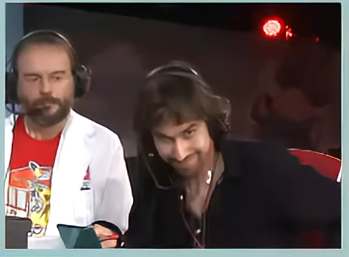
Wolfe Glick mugging for the camera after getting a world-championship-winning call on his opponent’s protect. (Video attached to the image at the turn in question)
VGC has also stayed remarkably balanced throughout its years. There have been consistently good Pokemon, including the eternal terror Incineroar who I will speak more on later, but there are often many ways to use format staples and many ways to answer them. TPC uses a system of regulations to allow or disallow certain Pokemon, and the results often create metagames where unusual Pokemon can shine where they might be otherwise outclassed. Even in more inclusive formats where players can use the super-powerful legendary Pokemon that are otherwise restricted there are loads of sneaky ways to gain advantages with otherwise-unimpressive Pokemon. For instance, in 2016’s incredibly high-powered format Wolfe Glick won the world championships using a team with a Raichu, whose ability lightning rod (which redirects opposing electric-type attacks to the user who gains special atack from them rather than taking damage or an effect) to protect his Kyogre (that year’s runner-up Jonothan Evans found a similar strategy using Manectric, who also has the lightning rod ability before mega-evolving). This ability to surprise opponents with niche tech is a sign of a good format.
While doubles is quite compelling, the main way many expect competitive Pokemon to work is as they do in the games- 6v6 single battles. While TPC doesn’t have an official 6v6 singles format, there is a highly popular singles format called Smogon singles. Until quite recently, this was the main example people thought of when they heard “competitive Pokemon,” and for good reason. While VGC was limited to in-person events that were rarely well-showcased online, Smogon was incredibly accessible to play and watch. No longer did you have to painstakingly breed a team with perfect IVs (or reset constantly in the case of legendary Pokemon), train them to have perfect EVs, give them perfect moves, and find all the perfect items, with the power of the internet you can assemble a team in moments on pokemonshowdown.com.
There are so many benefits to using a simulator over the games themselves that it’s impossible to list them all. Not only is the process of creating a team incredibly easier, but finding resources is also much simpler. Are you unsure of your Pokemon’s speed compared to your opponent? Mouse over them and you’ll see a range of their potential speeds. The same goes for a Pokemon’s potential ability, revealed item, revealed moves, and so much more. Moreover, knowing what to put on a team is easier too- within the teambuilder you’ll find links to analysis that includes movesets, stat spreads, explanations for those sets, and team options to use with or against a pokemon. Add onto this quicker battles, fast queue times, and the potential for formats like random battles (where both players are given random teams of roughly equal strength) which would be impossible on cartridge and you can understand why this format dominated for years.
When I brought up my love for singles to a friend, they asked “don’t they have to ban stuff?” The answer is yes, but I find the things they ban more than acceptable. Moves that one-hit-KO the opponent are banned, evasion moves are banned, the sleep and freeze status are limited to one Pokemon (a rule which comes from Pokemon’s first battle simulator, Pokemon Stadium), and Pokemon above a format’s power level are banned among a few other things which usually depend on the format. I find these bans fine because they result in a more fun, interesting, and competitive game. They either introduce an unhealthy amount of luck to the game or they restrict what is viable- especially considering the difficulty in playing around these elements- so rather than limit play greatly they ban toxic strategies which in turn allows more ideas to thrive. But what defines something as unhealthy, especially in terms of power?
Here is where the genius in Smogon’s system appears- Pokemon are divided into playable tiers defined by usage. If a Pokemon is used often enough by strong players it becomes a part of a tier and cannot be used in lower tiers, and if it doesn’t meet that usage threshold then it goes down in a tier until it meets that usage. This means Pokemon below the power level of one metagame can thrive in another. Consider my beloved Torterra- though my beloved Sinnoh starter is too weak for standard play (OU, short for OverUsed), I can still viably use it competitively in the lower tier of RU (Rarely Used). This system allows you to use your favorite Pokemon while still playing to win, resulting in the best of both worlds.
One common complaint about Smogon singles is the prevalence of stall teams which seek to wear down the opponent through passive damage via status conditions, entry hazards, or other means. This complaint has some merits- a highly defensive team is certainly annoying to fight and can take much longer than a match against a balanced or offensive team- but is vastly overblown. Stall teams tend to be matchup-dependent and can often be broken down through a few different strategies. Take this video from Smogon player Freezai.
(Yes the title is clickbaity but it’s a good video)
Early on he identifies his game plan- use Ferrothorn to set hazards (spikes and stealth rock, which in singles are common and near-mandatory respectively) to punish stall’s tendency to switch, set up rain with Pelliper, and break through with Crawdaunt. Moreover, he identifies what won’t work- his Zapdos, Seismitoad, and Barraskewda are all handled by the opponents’ defensive core- and acts accordingly, moving with great deliberation and intent rather than attacking pointlessly. He also adjusts his plans, realizing that his Barraskewda becomes a much more powerful attacking piece after he KO’s the opponent’s Toxapex. I highly recommend this video and Freezai’s content in general as a view into competitive Pokemon and Showdown’s many interesting metagames.
I also think players (especially young/inexperienced players) fail to recognize the weaknesses or ways defensive Pokemon can be exploited, only seeing the frustration of getting countered and not the ways around the wall blocking their path. To illustrate more counterplay around defense, consider generation 3 OU (that’s another benefit of Showdown, you can play older generations unlike VGC which only supports the current game). In gen 3, passive damage is very powerful. One of the main strategies is called TSS, which seeks to wear down the opponent with passive damage through toxic, spikes, and the permanent sandstorm set by Tyranitar (before generation 6, weather set by abilities like Tyranitar’s sand stream were permanent, and only cancelled through other weather abilities or manually through moves like rain dance). The metagame revolves around these ideas, and accounting for them in teambuilding and in game is key. This results in a fantastic, strategic metagame with a perfect balance of clear roles, surprise, and tension as players dodge around threats and answers. While this can involve stalling, the result isn’t a snooze-fest where both players switch around and do nothing, but a dance where players jockey for a good position to attack, set up or remove hazards, or enact another long-term plan. With the metagame’s tendency towards bulk, endgames are often tense, precise endeavors where managing odds and understanding your win conditions is key.
There’s a lot to say about Smogon singles, and perhaps I’ll say it another time. I bring it up here not only to rave about an interest, but to say that while I love Smogon singles, Pokemon Champions not being or having Smogon singles isn’t my problem with the game. I do find it disappointing that you can’t even play 6v6 matches in private games, but with Nintendo’s tendency towards ignoring or being hostile towards fan-driven competitive scenes for their games you’d have to be a fool to expect them to bless Smogon. My issues are not with how the game is played, but in the surrounding factors.
For one, the game is free-to-play and has the scummy features you’d expect for monetization in that format. There’s daily quests, a battle pass, a membership which is either five dollars for a month or fifty for twelve months (the game notes this as being “Good value!”), in-game currencies, and most frustratingly, a gacha system for collecting Pokemon. Once every day (or more with an in-game currency that you cannot buy- yet) you see a lineup of ten Pokemon and pick one to recruit. This system is already bad, particularly so when compared to Pokemon Showdown where to put a Pokemon on your team you just have to click on them, but especially so when you consider the available Pokemon. Some complained about the limited dex and were responded to with the refrain that a smaller pool of Pokemon is standard for VGC, but the good part of a smaller group to pick from is that you get more variety- without the game’s strongest Pokemon lesser ones are playable or even strong. This is somewhat true for the current format, but weakened by the absurd power in a small handful of Pokemon.
Sneasler and Incineroar are menaces. Incineroar isn’t as obviously problematic, but it makes far more Pokemon unviable. It does nearly everything you’d want a support pokemon to do. Fake out disrupts, it’s ability intimidate weakens foes, parting shot weakens foes and allows it to switch out- meaning it can re-enter to re-apply intimidate and threaten fakeout, it hits fairly hard, and it can run a litany of other moves to do just about anything you want. With Incineroar in the game there’s little reason to run many of the other similar pokemon, and with slightly more pokemon available than there are in the series’ first games that’s a disaster for variety. If you don’t believe Incineroar is that centralizing a force, consider that at the current date of writing, five of the top ten pokemon used either outright counter Incineroar or hit it hard- not to mention the more niche options also being used, and it is still the third-most used pokemon in the format. That’s how strong it is.
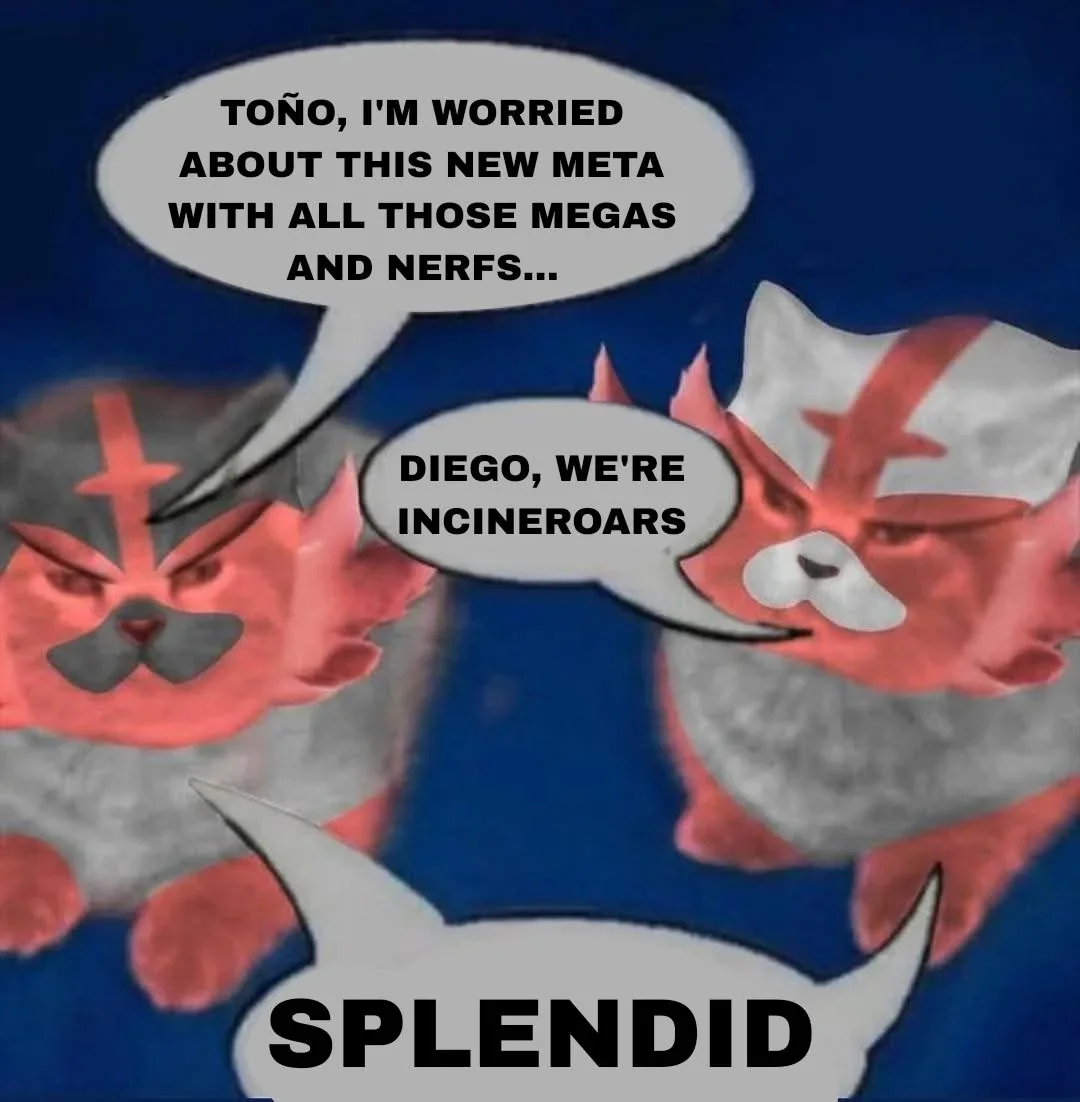
A reddit post from r/stunfisk by TOMRANDOM_6 (link attached to the image)
Moreover, there’s Sneasler. Sneasler’s main draw is that it is both one of the strongest attackers in the format and nearly unrivaled in speed. Every metagame has its strongest attackers, but often they’re exploitable- not so much with Sneasler. Though it is relatively frail, it can blast through so many of the game’s attackers that it hardly matters. While you can use intimidate to weaken its physical attacks, if Sneasler runs the white herb (which the user consumes to reverse the first stat drop it faces), that intimidate does nothing but double Sneasler’s speed due to its ability unburden (which doubles the user’s speed if its item is consumed). Even if you manage to outspeed it or withstand an attack, you might not be able to one-shot Sneasler back because it might hold the focus sash (which consumes itself if the user is KO’d from full HP to live at 1 HP instead). Even if that nightmarish question of what item your opponent’s Sneasler runs wasn’t a problem, there’s also its signature move dire claw to account for. This move has a 30% chance of paralyzing, poisoning, or putting the target to sleep on hit, allowing it a random chance to bail itself or your team out of a losing spot. It is a pokemon so dominant that it contributes to never-before-seen pokemon like Ariados and Aerodactyl being used in large part because they are strong against it. Together, these two pokemon severely warp the metagame around themselves, meaning if you don’t hit these two in your 10-pokemon gacha pulls you might just be screwed.
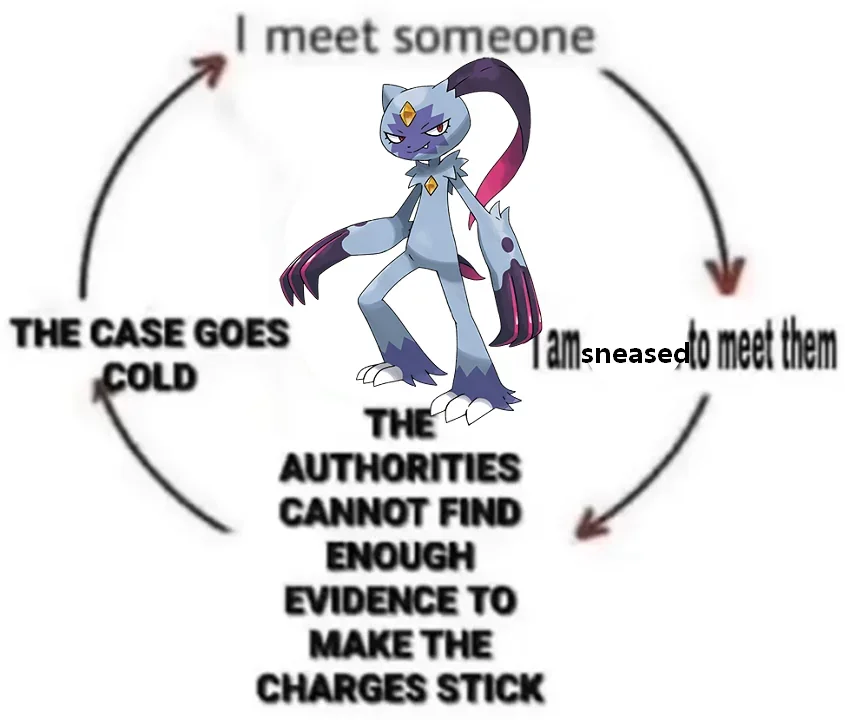
A reddit post from r/stunfisk by Glavenus_Guy (link attached to image)
You can build teams without these strong pieces, but nothing comes close to them in power. In fact, I took a look through the 186 available pokemon and found roughly 60 that I would almost never use, and certainly wouldn’t use in this format. Unless you’re lucky enough to hit your preferred pokemon in your gacha or have them in another game and transfer them over, you’re missing out. And if you want to switch up your team with another option it’s the same song and dance.
I’ve been talking in general about the game while primarily discussing the doubles format, and that’s because I’m not a fan of the game’s single battle format. There are advantages to a bring-6-pick-3 format, for instance you’re not punished if a matchup-dependant pokemon misses a good matchup because you can just not bring it, but I find them outweighed by the disadvantages- namely the shorter games which incentivize going for the jugular much faster and disincentivize the methodical, more balanced play you’ll often find in 6v6. For the most part, I imagine people playing Champions are primarily interested in double battles, and I can’t blame them- the game seems heavily tailored towards that format.
The most aggravating element in the game is easily the limits on teams and your “box”. One of the coolest things about competitive pokemon is that the same species of pokemon can be run in a variety of ways, but in Champions if you want to use one pokemon a certain way on one team and a different way on another, when you switch teams you’ll also have to re-train that pokemon, changing its moves and stat spread using the in-game currency VP (which you cannot purchase, yet). This process is much simpler than it would be in the base games, but it’s also a far bigger hassle than Pokemon Showdown, where the process is just clicking what you want a pokemon’s stats and moves to be. Moreover, the game limits you to three teams without purchasing a membership. That’s nothing. If you want to have teams for multiple formats, experiment while keeping a copy of your original team, you’re out of luck (unless, of course, you pay). One of the most fun things about Pokemon Showdown is how simple it is to make a team and use it. If you have an idea, you can quickly turn that idea into reality and go right into a battle. Not so in Champions. Building teams is much more tedious with you having to scroll through your items which, by the way, you have to purchase with VP. On top of all this, the game limits you to 50 total pokemon you can recruit, so if you want to have one bulky garchomp for single battles and one fast, attacking garchomp for double battles you’re using two of your limited slots on the same pokemon (unless, of course, you pay).
Perhaps I’ve been spoiled. I don’t think so. I think if a group of fans can create a product that includes far more content, is far easier to use, has far more tools, is directly tied to a community, and is better programmed than The Pokemon Company can then there’s not much point to them doing so at all. I want to be optimistic about Pokemon Champions. I love competitive pokemon, and this game does make it far easier to engage in competitive pokemon in an official capacity. This game is undeniably a massive step forward for official competition (playing competitively on official hardware was incredibly difficult and time-consuming). But that’s it. The only legs Champions has over Showdown are the fact that it’s an official game, has pretty solid visuals, and some very good animations. Beyond that, all it offers is the admittedly very fun experience of playing competitive pokemon.
No matter how the game leaves me feeling, I still find myself playing.